Showing posts with label nutrition. Show all posts

Sunday, November 02, 2008

Tools of the Trade


In the software engineering world we throw around a phrase, "You can't improve a process you can't measure" and in NLP we say "If you don't know where you are going, how do you know when you've gotten there?"

Leigh Peele of "The Fat Loss Troubleshooter" posted a fantastic article entitled "The Reality of Calories" which included a video that very graphically illustrates the point:


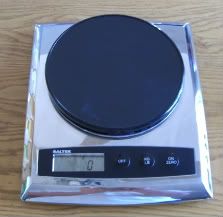
So what tools do I use to measure and keep track of my processes? As the video showed, a digital scale is essential. If you spend any time whatsoever logging food, you will notice that there is very little consistency in how portions are measured, if you are trying to use the English system. However almost every food label will show the serving size in grams, which is more accurate anyway. Spending a week or two measuring portions to the gram can be a very educational experience.
As far as software/online tools go, I have 3 sites I consider indispensable:

  1. PhysicsDiet.com
  2. TheDailyPlate.com
  3. Gyminee.com
Physics Diet

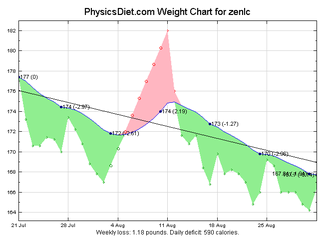
Regular readers have seen me talk about this site before so I won't go into a lot of detail. Essentially, you enter a weight (and optionally other data like body fat, exercise calories, etc.) and it shows you over time what your weight is doing as well as averages your weight to help smooth out the panic over those day-to-day fluctuations we all have. The site will also use this data to show surplus or deficit calories for a given time period. This is an extremely important function because all intake and expenditure numbers are estimates and one never knows how accurate the estimates are until they have a few weeks of data.


TheDailyPlate

TheDailyPlate is a nutrition tracking site. If you read my post on figuring nutritional requirements, you understand how important it is to track the macro nutrients as well as calories. TheDailyPlate makes this process easy by having a very extensive database of foods, including the ability to search other user-contributed foods. Users also have the ability to create "meals" - a combination of foods eaten regularly such as bacon and eggs for breakfast.

TheDailyPlate will also track calories burned from exercise and automatically subtract those from amount consumed. It includes the ability to set calorie goals and track weight over time as well.

One very nice feature is the pie graph showing calories consumed that day. For those of us that are strongly visual-oriented it is a great way to see at a glance how the intake has been so far.

Gyminee

I was looking around for an easy to use workout log to take with me to the gym and happened to see this site mentioned for online logging on a bodybuilding forum. Aside from a well-designed printable log, the site has some nice features. When designing a workout, one has the ability to choose from a decent array of exercises, either cardio or strength, with the strength broken down by body part. There is the option to completely create your own workout or you can "join" workouts created by others. I saw a decent mix of upper/lower splits, Rippetoe's beginner workouts, 5x5s, etc.

Each exercise is either described well or has a video and as you progress you can look at total reps performed over time, total weight lifted or max weight lifted as a measure of checking progress from workout to workout.

Both TheDailyPlate and Gyminee have a lot of "social networking" options such as chats, blogs, forums, etc. Gyminee also will track weight and nutrition however I have not tried the nutrition feature yet.

As the diet and fitness industry continues to take greater advantage of the internet and online interaction, more and more tools become available to help us in our quest to ride that century or push the iron. I hope some of you will take advantage of these tools to realize your own goals.

Thursday, October 30, 2008

Examining Daily Calorie Expenditure

I promised a couple of weeks ago to start posting about things I am learning in relation to nutrition and exercise and perhaps the best place to start is with figuring out where calories go and what the body does with them.

Thermodynamics are pretty clear:
calories in + calories out = surplus/deficit.

There are some cases where this formula seems to break down however they are outside the scope of this overview.

As one would imagine, the formula above is just an easy to remember simplification. The calories in part is of course the food we eat and seems fairly clear cut although I will have some thoughts on this at the bottom.

The calories out part of the equation is where things get really interesting. Caloric expenditure can be broken down as follows:

  • Basal Metabolic Rate (BMR) - This is the base number of calories one's body needs just to stay alive. A quick and fairly accurate estimate is 10-11cal/lb of body weight.
  • Thermic Effect of Food (TEF) - Believe it or not, it costs energy to digest food. The amount of energy it takes is dependent on the type of food being processed. TEF can account for 20% of expenditure. More on this below.
  • Activity Thermogenesis - Calories burned through movement. There are two parts to consider:
  1. Thermogenic Exercise Activity (TEA) - Calories burned through exercise.
  2. Non-Exercise Activity Thermogenesis (NEAT) - Calories burned through moving, walking, fidgeting, etc. but not related to exercise. This value is highly variable and can account for as little as 15% to as high as 50% of caloric expenditure.
OK, um, so what does all this mean? It means figuring caloric requirements is as much art as science. Let's look at an example:

I started bulking at 165 pounds. I was lifting 3 times per week and doing some swimming a couple of times, too. Let's use 10 cal/lb for BMR:

165 * 10 = 1650

That number is a guess at the number of calories I need to just lay in bed and breathe. Now, obviously I'm going to do a bit more than that - I'm also going to eat! I eat a lot of protein which has the highest TEF, so let's figure a full 20%:

(1650* .2) + 1650= 1980 calories for maintenance on rest days.

Now if we figure in either a half hour of swimming or an hour of lifting, we get

1980 + 500 = 2480 calories for maintenance on exercise days.

Using that number as a base, I can then watch my weight over a period of time using a site like Physics Diet and determine if those numbers are correct or need tweaking.

Thoughts on TEF

Just as different foods yield different amounts of energy when consumed, they also require different amounts of energy to process. Fats have the highest caloric value and the lowest TEF value at only 2 or 3% and protein gives the highest TEF at up to 30%. Fibrous vegetables provide so few calories and are so hard to process they can actually have a negetive energy contribution once TEF is included.

Thus it is reasonably easy to see why the MANS diet is so useful for gaining muscle while bodybuilding. High protein insures muscles have what they need for repair plus the veggies all give great bang for the TEF buck and the fat content serves to provide most of the non-exercise energy requirements.

I hope this overview will help everyone dial in their calorie requirements, whether bulking or cutting.

Monday, August 25, 2008

Time Passes


I realize it's been a while since I updated my blog. I've been in a rather anti-social mood lately and have withdrawn into my shell a bit.

For anyone that doesn't know, I ended up DNFing (Did Not Finish) the only paid bicycling event I will attend this year, the Triple Bypass. I'm not exactly certain what happened other than I feel that my wonderful "training plan" was inadequate, particularly after my wife made me cut back my training hours in the spring. Even at that, we had another argument just after the event was over in which she voiced displeasure at how much training time I take. At this moment I have no idea if I will attempt Triple Bypass again next year or not. After this last argument I can honestly say I have little desire to ride and after a visit to BlueEyedBikinBabe-land in September, I plan on hanging my bike for the fall and winter to concentrate on bodybuilding and swimming.

Fear not, though, I have not been idle in all this free time. I have been studying nutrition and physiology even more deeply than before. Most of my information comes from the brilliant Lyle McDonald at BodyRecomposition.com. If anyone wants some extremely good information on fat loss or muscle building, BR is the place to go. Here is a short list of articles I've been reading from Lyle:

"What is Bodyfat?"
"Fat loss for Athletes" Part 1, Part 2, Part 3
"How Detail Oriented Do You Need To Be?"
"Metabolic Rate: Overview"
"Is A Calorie A Calorie?"

Extremely interesting stuff. I would encourage everyone to go have a look.

Saturday, February 09, 2008

It's All About the Sugars, Baby

Glycemic Index

The Glycemic Index (or GI) of a food is defined as the area under a two-hour blood glucose response curve. In other words, the GI of a food is a measure of how much glucose (sugar) is dumped into our blood stream over a two hour period. But why do we care about blood glucose? Because of the hormone insulin. Insulin is secreted in response to high blood glucose levels. If there is more glucose in our blood than we can use as fuel, insulin scrubs the glucose out of the body by storing it as fat. A side-effect of this mechanism is then blood sugar levels get low, the body is signaled to increase hunger and get more glucose because we are obiously low on energy, thus creating a vicious cycle of eating, storing fat and crashing.

Unfortunately, even though it sounds good in theory to look at blood glucose of a food, how often do we make a meal out of only kidney beans? Most people eat meals with multiple ingredients, each one of which will affect the blood glucose curve. For example, fats and protiens have little effect on blood glucose or insulin and when eaten with a high GI food, will slow down the absorption of the sugar and decrease the GI.

Foods are broken in high, medium and low GI values thus:

  • High - 70 or greater
  • Med - 55 - 70
  • Low - 55 or less.
An excellent resource for Glycemic Index is the Home of the Glycemic Index managed by the University of Sydney.

Glycemic Load

The Glycemic Index is based off of a 50 gram portion of food and the height of the blood glucose curve. It stands to reason, then, that a 25 gram portion of the same food would only produce a curve half of the height. Therefore portion size tends to mitigate GI also. Glycemic Load is a calculation used to take this fact into account.

The calculation goes like this:

The quantity (in grams) of a food's carbohydrate content, multiplied by its GI, and divided by 100.

For example, a 100g slice of watermelon has a GI of 72 but only 5g of carbohydrates. This gives us
(5g carbs * 72 GI)/100 = 3.6 GL

In comparison, a banana has a GI of 52 (avg) and carbohydrate count of 20g. This gives us (20g * 52 GI)/100 = 10.4 GL and white rice with a GI of 64 and 24g carbs/serving has a Glycemic Load of (64 * 24g)/100 = 15.4 GL.

Watermelon is a high GI food, banana is low GI and rice is medium, and yet as you can see, the Glycemic Load of each food is not predicted solely by Glycemic Index.

Insulin

So insulin looks like the bad guy in all of this. It causes fat storage. It causes energy crashes. Insulin resistance (Metabolic Syndrome) has been linked to all kinds of health problems, including Type II Diabetes. Why then would we want insulin? I'll tell you:

For up to two hours after exercise, the body is very receptive to insulin's effects of delivering glucose to muscles. As a matter of fact, muscles are two to three times more receptive than at other times. This is the mechanism behind all of those fancy "recovery" drinks that are on the market now. The drinks are really just fancy forms of sugar water pushed into the muscles by insulin. The body is just as well served by chocolate milk, Smarties, or glucose tablets as long as they are consumed quickly post-exertion.

Studies also show that a bit of protein helps the body store glycogen as well. Most articles say the ratio should be 4 parts carbohydrate to 1 part protein and as little fat as possible (since fat delays absorption of the sugars) and the sugars themselves should be as high Glycemic Index as possible.

This means probably the best post-exercise snack one could have is 6 packages of Smarties (150g glucose) and 2 eggs (13g protein). I think I'll stick to the chocolate milk :D.